Selling arms at Farnborough
While negotiations for an international Arms Trade Treaty take place in New York, the government presence at Farnborough International makes a mockery of the UK's commitment to arms controls.
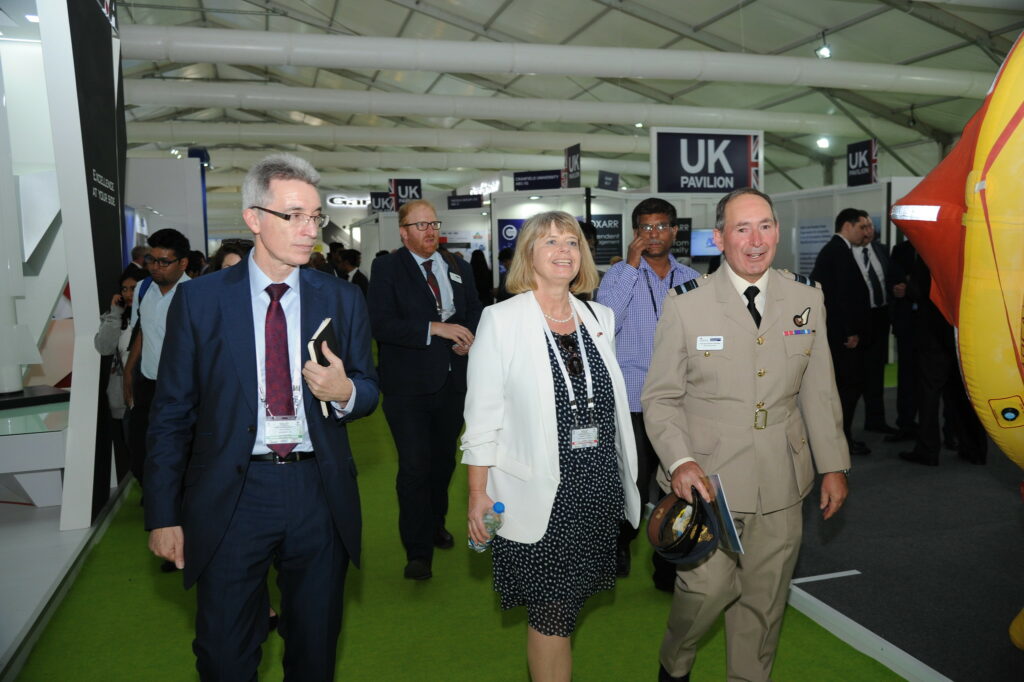
Government ministers and civil servants will be out in force at Farnborough International 2010, wooing arms buyers from across the globe – including representatives of authoritarian regimes, human rights abusers and countries involved in conflict.
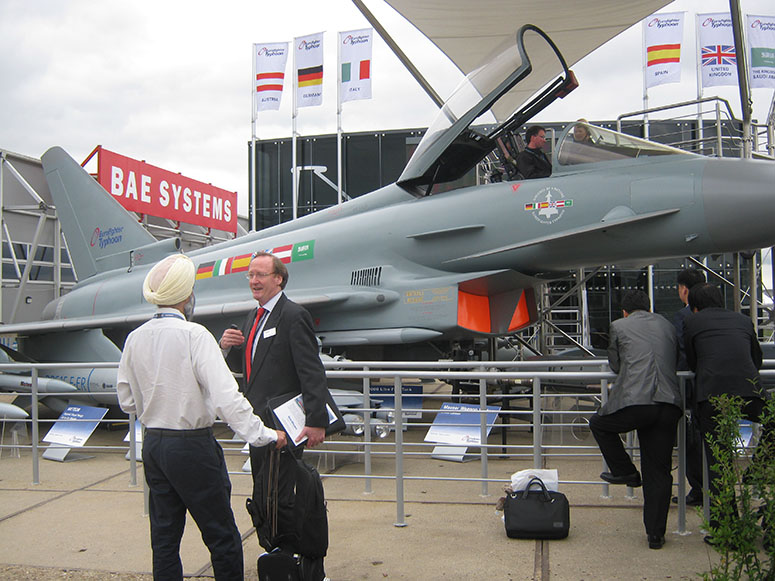
Farnborough is one of the UK's leading arms fairs. For five days, military delegations from across the world will browse displays of weaponry, network and arrange deals. The public airshow that rounds off the event may be great publicity and a good money-making exercise for the industry but, as the Chairman of the event says, the aim of the show is to "gain good business".
Trade organisation Aerospace, Defence and Security (ADS) owns, organises and profits from Farnborough, but is ably assisted by UK taxpayers, who fund a government arms sales team.
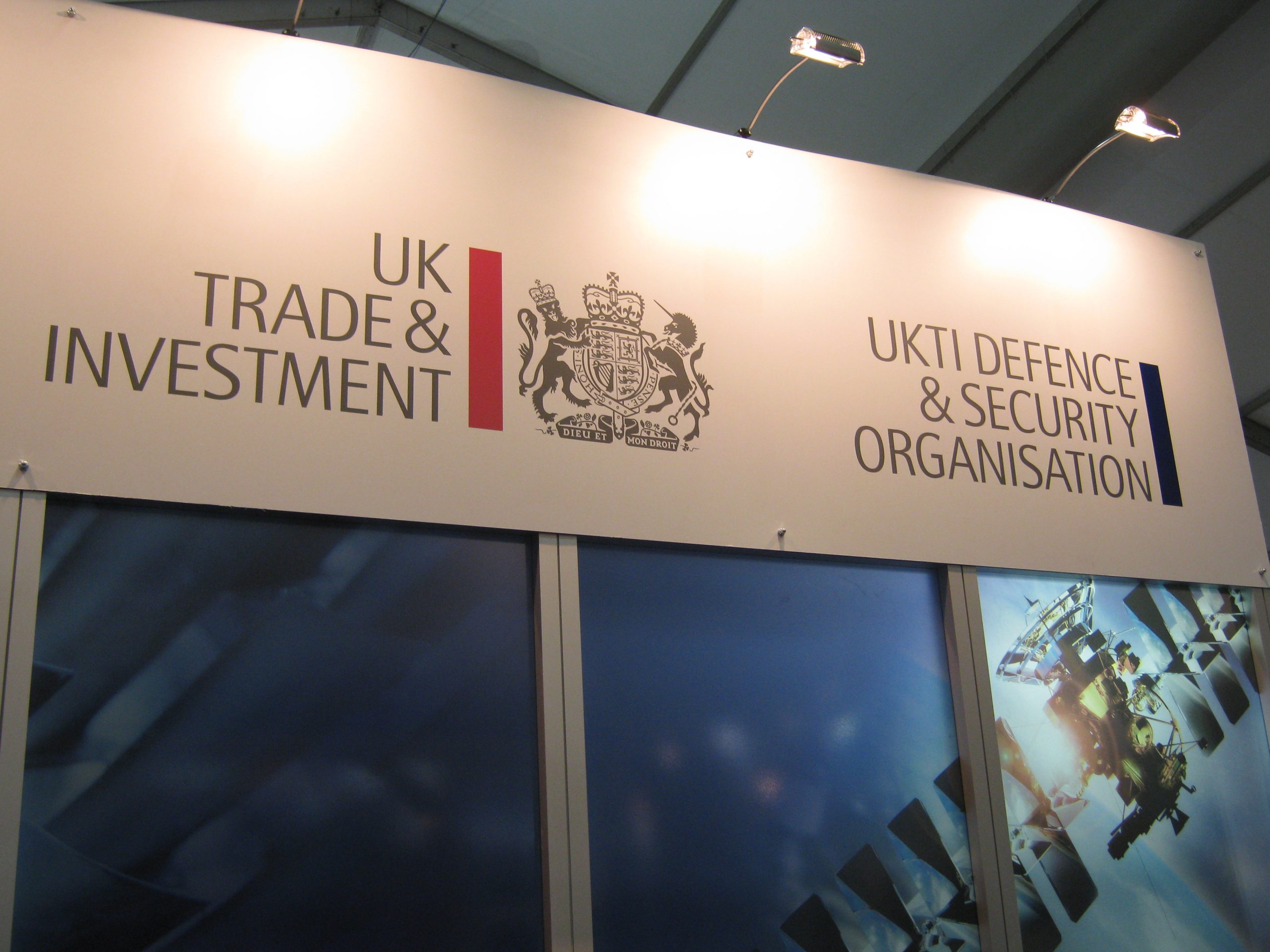
UK Trade & Investment Defence & Security Organisation (UKTI DSO) is a government unit that exists to help company sell arms. It "works in close partnership" with ADS to organise Farnborough. Its role includes
- Inviting and hosting international delegations representing 40 governments. Its list of priority markets for UK arms sales include countries with serious conflict and human rights concerns or urgent development needs
- Arranging meetings between international buyers and exhibitors
- Marshalling a sales team from all parts of government including a strong presence of Ministers who will be "at the forefront of promoting...UK capabilities".
The government's rhetorical allusions to arms control mean next to nothing when its policy and practice is to sell arms. [more]
The new Coalition Government has said "We will support defence jobs through exports that are used for legitimate purposes, not internal repression"
It provides no definition of "legitimate purposes".
Is there to be any change from previous practice where military equipment exported from the UK was used by Israel in Lebanon and Gaza; where the sale of fighter jets to Saudi Arabia took precedence over the possibility of effective UK government protests over human rights concerns and a criminal investigation for bribery; and where an expensive and useless military radar system was successfully promoted to Tanzania?
There are already criteria that say that exports will not be permitted if they might be used for internal repression. That has not stopped UK military exports going to countries such as China, Israel, Sri Lanka and Thailand where it is impossible to be sure that they will not contribute to internal repression.
As long as arms promotion is seen as the business of government there is no prospect of arms control.
close
In any case, a Government concerned about boosting employment should not look at military export jobs to do this. Arms export jobs are heavily subsidised by the taxpayer, a subsidy that could be directed to more productive alternatives, one being renewable energy technologies. Investment here would have a security benefit that is in stark contrast to the instability and conflict promoted by the arms trade and could establish a UK presence in a vibrant, growing sector.
Furthermore, it is a myth that vast numbers of jobs are currently supported by arms exports. In fact, these account for 0.2% of the UK workforce and less than 2% of manufacturing employment. The buying countries also increasingly want to have part of the production progress. The sale of Eurofighters to Saudi Arabia illustrates this. Two thirds of the 72 Eurofighters sold to Saudi Arabia are to be assembled there. Similarly, 66 Hawk jets were sold to India, but 42 are being manufactured under licence in India by HAL.
Buyers: military delegations
Algeria
Algeria is an authoritarian regime and one of UKTI DSO's "Priority markets". Arms export licences to the value of nearly £7 million were granted in 2009. [more]
...That year, plans were announced to establish a UKTI DSO post at the British Embassy. In May 2010 UKTI DSO coordinated a Defence Industry Day in Algerian waters, using a Royal Navy Ship and military staff to provide a high-prestige floating exhibition space for companies to promote their arms. Algeria has also been one of the focuses of UKTI DSO facilitated "high-level interventions" in the promotion of arms exports, using the Prime Minister and Defence Secretary.
In late 2009 Algeria made a substantial order for helicopters from AgustaWestland, some to be produced in Algeria under licence. The purchases were aimed at meeting both its "battlefield and internal security requirements". The order followed on from a 2007 deal. As Jane's Defence Weekly stated, "The UK is working to make up for lost time since lifting an arms embargo against Algeria in 2005". According to The Sunday Times, the Algerian authorities asked that the deal should not be publicised.
close
China
China's human rights record is notoriously poor and there are several conflicts taking place in the country. Despite a "partial" embargo on arms to China, it remains a substantial market for UK arms. [more]
...Restrictions on arms exports to China are the result of a European Union military embargo, with "interpretation" left to each member country. The UK interprets the ban as covering "lethal weapons", but a wide range of other military equipment, often vital for the "lethal weapons" to be effective, is permitted. In 2009, arms export licences approved by the UK Government included weapon sights, "technology for the production of combat aircraft", and components for each of: air-to-air missiles, combat aircraft, military aero-engines, military utility helicopters and military infrared/thermal imaging equipment.
Staff of UKTI DSO have met with military representatives from China, and a military delegation was invited to the 2009 DSEi arms fair in London.
close
Libya
Libya is another authoritarian regime with a poor human rights record. It has long been a priority market for UKTI DSO, which has helped a number of companies market and sell there - including US company General Dynamics. [more]
In September 2009, a Libyan delegation was invited to the DSEi arms fair. UKTI DSO in turn exhibited at the Libyan Aviation Exhibition (LAVEX) the following month.
In 2009 Libya was in the news amid controversy over the release, on compassionate grounds, of Abdul Baset Ali al-Megrahi, convicted of the Lockerbie bombing. It turned out that "high-level interventions" promoting arms exports, arranged by UKTI DSO, had taken place in advance of the decision. When The Times approached UKTI DSO about these interventions, its spokesman initially claimed that the information had been made up. When given the evidence he said "We have been working very hard with Libya for a number of years on normalising relations and looking at their defence requirements. It would be quite wrong to make any direct link between this and the PTA" [the Prison Transfer Agreement that allowed al-Megrahi’s release].
close
Saudi Arabia
Saudi Arabia is an authoritarian regime with an appalling human rights record. It is involved in a conflict in its border region with Yemen, which started in late 2009. Saudi Arabia has been one of the most important UK arms markets for decades, and massive BAE arms deals with the regime have been riddled with corruption. [more]
Although UK Serious Fraud Office investigations were stopped following political intervention by Tony Blair (following in turn from pressure by the Saudi government and BAE), a US Department of Justice (DOJ) investigation continued into this and other deals. On 1 March 2010 BAE was sentenced "to pay a $400 million criminal fine, one of the largest criminal fines in the history of DOJ’s ongoing effort to combat overseas corruption in international business and enforce U.S. export control laws."
The court documents described BAE Systems "providing substantial benefits to a foreign public official of KSA [Kingdom of Saudi Arabia], who was in a position of influence regarding sales of fighter jets, other defense materials and related support services... In addition...BAES agreed to transfer more than £10 million plus more than $9 million to a bank account in Switzerland controlled by an intermediary, being aware that there was a high probability that the intermediary would transfer part of these payments to the same KSA official." (See DOJ press release)
UKTI DSO has organised many meetings between arms companies and Saudi Arabian military officials, and arms sales to Saudi Arabia also receive notable support beyond UKTI. Within the Ministry of Defence there is a team of 210 UK civil servants and military personnel known as the Ministry of Defence Saudi Armed Forces Project, or MODSAP. It exists to service Saudi arms contracts. The unit cost £48 million in 2008-9 but, astonishingly, it is entirely funded by the Saudi Government; UK public servants being paid by an overseas government to work for a private arms company.
close
Exhibitors
All of the world's top 10 arms companies will be attending Farnborough: BAE Systems, Lockheed Martin, Boeing, Northrop Grumman, General Dynamics, Raytheon, EADS, Finmeccanica (owners of AgustaWestland), L-3 Communications and Thales.
They will be joined by arms companies from around the world including:
- Elbit Systems and Rafael of Israel
- Korea Aerospace Industries
- Hindustan Aeronautics Limited of India
- Turkish Aerospace Industries
- ST Engineering of Singapore
- MiG, Sukhoi & Tactical Missiles Corporation of Russia
Also see CAAT blog "Farnborough: an arms fair operating alongside a civil aerospace exhibition, obscured by an airshow".